One Partner, One Supply Chain: Preparing Your Shopify Brand for Q4
One Partner, One Supply Chain: Preparing Your Shopify Brand for Q4
Q4 is coming.
For Shopify brands, this is the season of bigger campaigns, higher order volumes, new product launches, and some of the year's biggest sales opportunities.
But there is another side to Q4 growth.
More orders mean more inventory.
More inventory means more supplier coordination.
More suppliers mean more communication.
And more fulfillment volume means more opportunities for something to go wrong.
If your sourcing, warehousing, fulfillment, and shipping are handled by different providers, Q4 can quickly become a coordination problem.
That's why growing Shopify brands are increasingly looking for a simpler approach:
One Partner. One Supply Chain. One Connected Workflow.
Instead of managing multiple disconnected providers, an integrated supply chain partner can connect:
Sourcing → Quality Control → Inventory → Warehousing → Fulfillment → Shipping
The goal isn't simply to reduce the number of suppliers.
It's to create one supply chain that works toward the same Q4 growth target.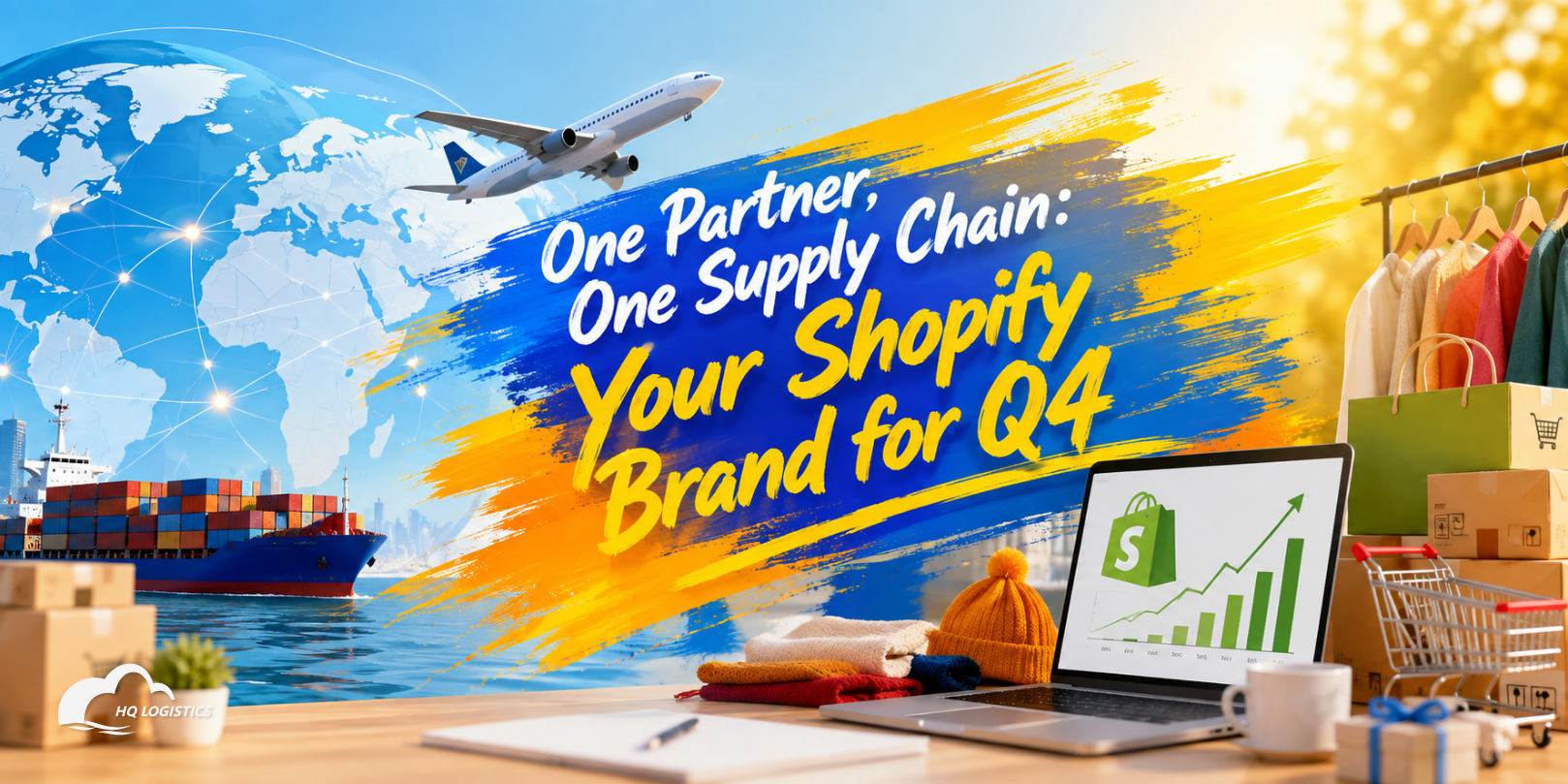
Why Q4 Is the Wrong Time for a Fragmented Supply Chain
During normal months, managing several vendors may seem manageable.
You might have:
One supplier for products | Another company for quality inspection | A warehouse for inventory | A fulfillment provider for orders | A shipping agent for international delivery | Another supplier for packaging
Each service may work individually.
The problem is what happens between them.
Who tells the supplier that demand is increasing?
Who checks whether enough inventory is arriving?
Who coordinates packaging?
Who knows which warehouse needs more stock?
Who adjusts shipping capacity when orders suddenly increase?
When every stage is managed separately, you become the connection between them.
That may work when your store processes a small number of orders.
It becomes much harder when Q4 turns 100 daily orders into 500 or 1,000.
A connected supply chain reduces those communication gaps and makes it easier to coordinate the entire operation.
What Does “One Partner, One Supply Chain” Actually Mean?
It doesn't necessarily mean that every physical operation has to happen in one location.
It means your major supply chain activities are coordinated through one strategic partner.
For a Shopify brand, that can include:
Product Sourcing
Finding products and reliable factories based on price, quality, and production capacity.
Supplier Management
Coordinating production schedules, replenishment, and supplier communication.
Quality Control
Checking products before inventory is sent to fulfillment.
Inventory Planning
Using sales data and seasonal demand to determine how much stock is needed.
Warehousing
Storing products in China or positioning inventory in overseas warehouses closer to customers.
Fulfillment
Picking, packing, labeling, and processing Shopify orders.
Shipping
Selecting shipping routes and solutions based on destination, cost, and delivery requirements.
Instead of seven disconnected processes, you have one connected supply chain.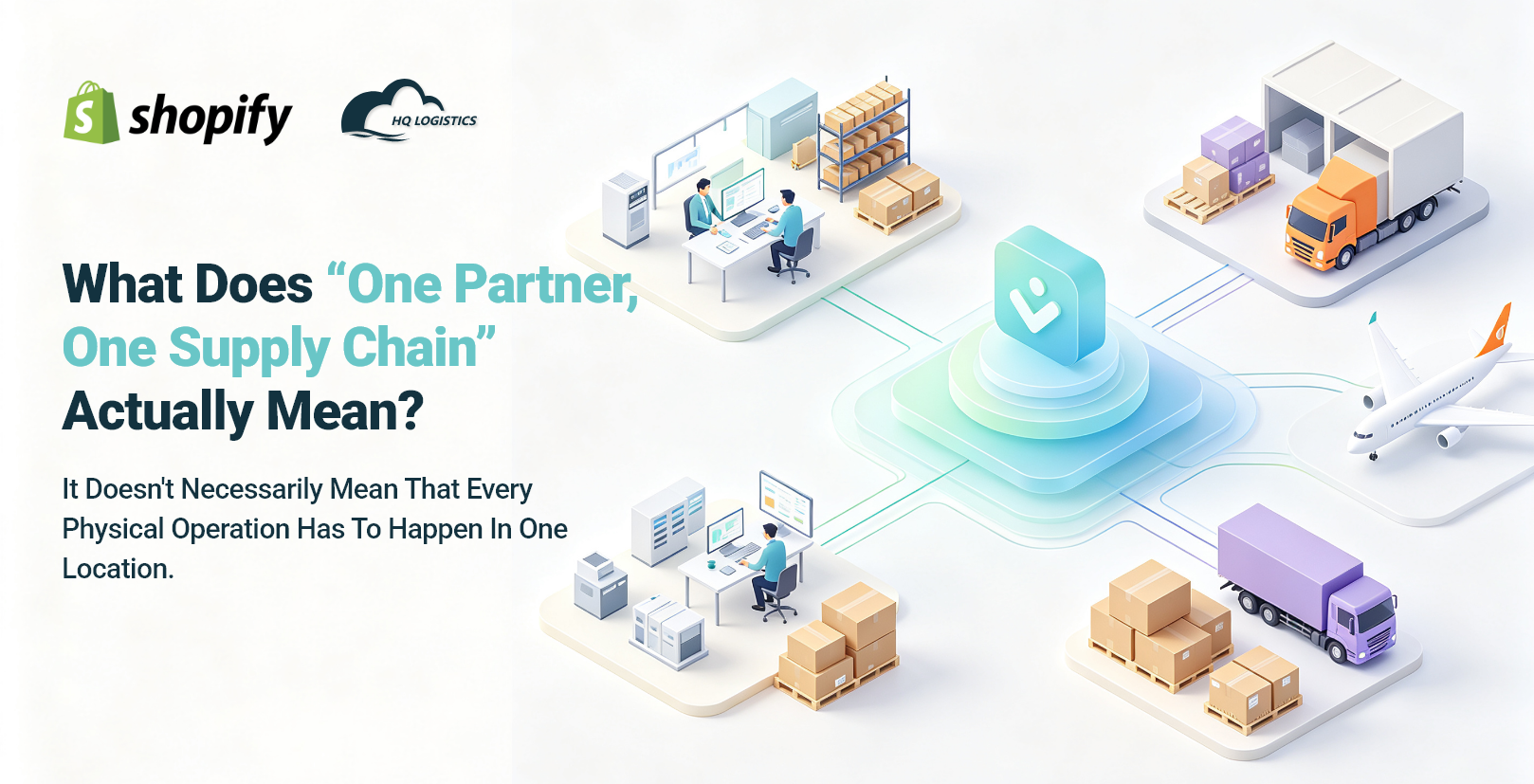
1. One Partner Makes Q4 Planning Easier
Q4 planning shouldn't begin when your first Black Friday order arrives.
It should begin weeks or months earlier.
You need to answer:
What will we sell?
How much will we sell?
Where will customers be located?
How much inventory should we prepare?
When should production start?
Where should inventory be stored?
How will orders be fulfilled?
Shopify recommends using historical sales, seasonal trends, promotions, and other demand signals to improve inventory forecasting. During peak periods, Shopify also recommends communicating more frequently with fulfillment providers about expected order volumes.
When sourcing, inventory, and fulfillment are managed by different companies, these decisions can become fragmented.
With one partner, the same supply chain team can look at the entire picture.
Sales Forecast → Inventory Plan → Supplier Production → Warehouse Capacity → Fulfillment Capacity → Shipping Plan
That's much easier to manage.
2. Better Communication Means Fewer Supply Chain Gaps
Communication is one of the hidden costs of a fragmented supply chain.
Imagine your Q4 campaign is expected to generate 2,000 orders.
Your marketing team knows.
Your Shopify store knows.
But does your supplier know?
Does your warehouse know?
Does your fulfillment team know?
Does your shipping provider know?
If information moves slowly between companies, your supply chain may react too late.
With one partner, important changes can be communicated across multiple stages at once.
For example:
Marketing Forecast Increases → Supplier Production Adjusted → Inventory Replenishment Increased → Warehouse Capacity Reserved → Fulfillment Resources Prepared → Shipping Capacity Confirmed
The earlier the supply chain reacts, the fewer emergency decisions you need to make during peak season.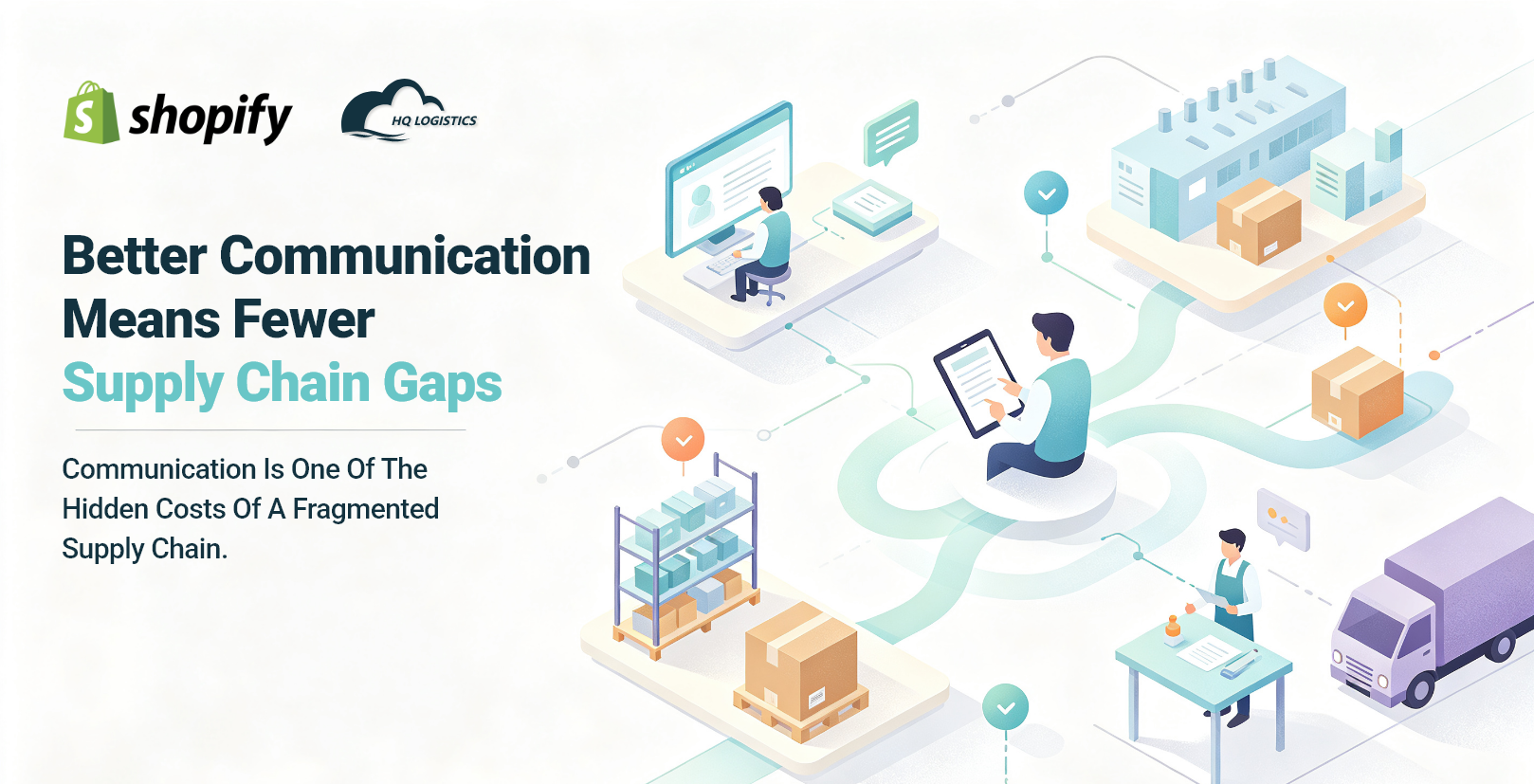
3. One Partner Can Help Connect Sourcing and Inventory
One of the biggest mistakes Shopify brands make is treating sourcing and inventory as separate decisions.
They are connected.
If a product suddenly becomes a bestseller, you don't just need more products.
You need to know:
Can the supplier increase production? | How long will replenishment take? | How much inventory is already available? | Where is the inventory located? | How quickly can additional stock arrive? | Should inventory be moved to an overseas warehouse?
Shopify's current inventory guidance emphasizes demand forecasting, reorder points, safety stock, supplier lead times, and inventory visibility as important parts of inventory management.
An integrated partner can connect these decisions instead of treating each one as an isolated task.
4. Quality Control Should Happen Before Fulfillment
Q4 is not the time to discover a product quality issue.
Imagine ordering 5,000 units for a holiday campaign and discovering after delivery that:
Product dimensions are incorrect | Packaging is damaged | Accessories are missing | Product colors don't match | Labels are incorrect
If quality control happens after inventory has already entered the fulfillment process, fixing the problem becomes more expensive.
A connected supply chain allows QC to sit between sourcing and fulfillment:
Factory → Quality Inspection → Approved Inventory → Warehouse → Fulfillment
This gives you an opportunity to identify problems before they become customer complaints.
For brands building long-term customer relationships, that's particularly important during Q4.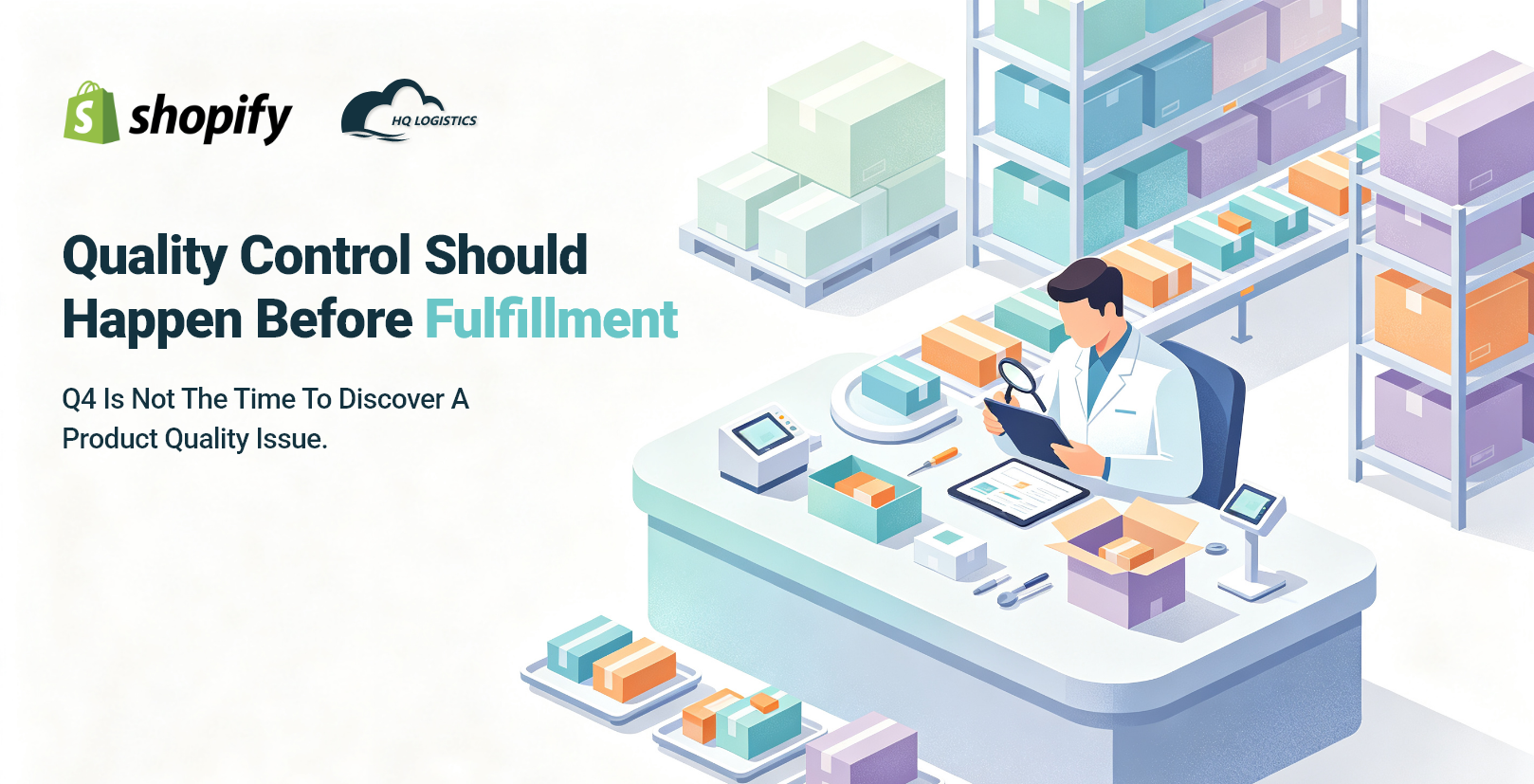
5. Inventory Positioning Becomes Easier With One Supply Chain Partner
Where your inventory sits can have a major impact on fulfillment performance.
If most of your customers are in the US, you may want to position some inventory in the US.
If Europe is your primary market, European inventory may make sense for your best-selling products.
A simple strategy could look like:
China → US Warehouse → EU Warehouse
Product sourcing, supplier coordination, and main inventory can be managed in China, while the US warehouse supports US customer fulfillment and the EU warehouse supports European customer fulfillment.
Shopify's holiday shipping guidance recommends preparing inventory early and notes that order routing can help send orders from fulfillment locations closer to customers.
The key is not simply having multiple warehouses.
It's coordinating them.
A strong supply chain partner should help you determine:
Which SKUs should go where?
How much inventory should each location hold?
When should stock be replenished?
When should inventory be transferred?
That turns warehousing from a storage decision into a strategic inventory decision.
6. One Fulfillment Partner Helps You Prepare for Order Spikes
Q4 demand rarely increases in a perfectly predictable way.
A campaign may perform better than expected.
A product may suddenly go viral.
A holiday promotion may generate thousands of orders in a few hours.
Your fulfillment operation needs to be ready for those scenarios.
Before peak season, confirm:
Warehouse capacity | Picking capacity | Packing capacity | Packaging supplies | Staffing | Order processing speed | Tracking synchronization | Carrier capacity
Shopify's latest fulfillment guidance highlights how growing merchants increasingly operate across multiple locations, markets, and delivery methods, making coordinated fulfillment more important as businesses scale.
One partner managing multiple stages can make it easier to adjust resources when demand changes.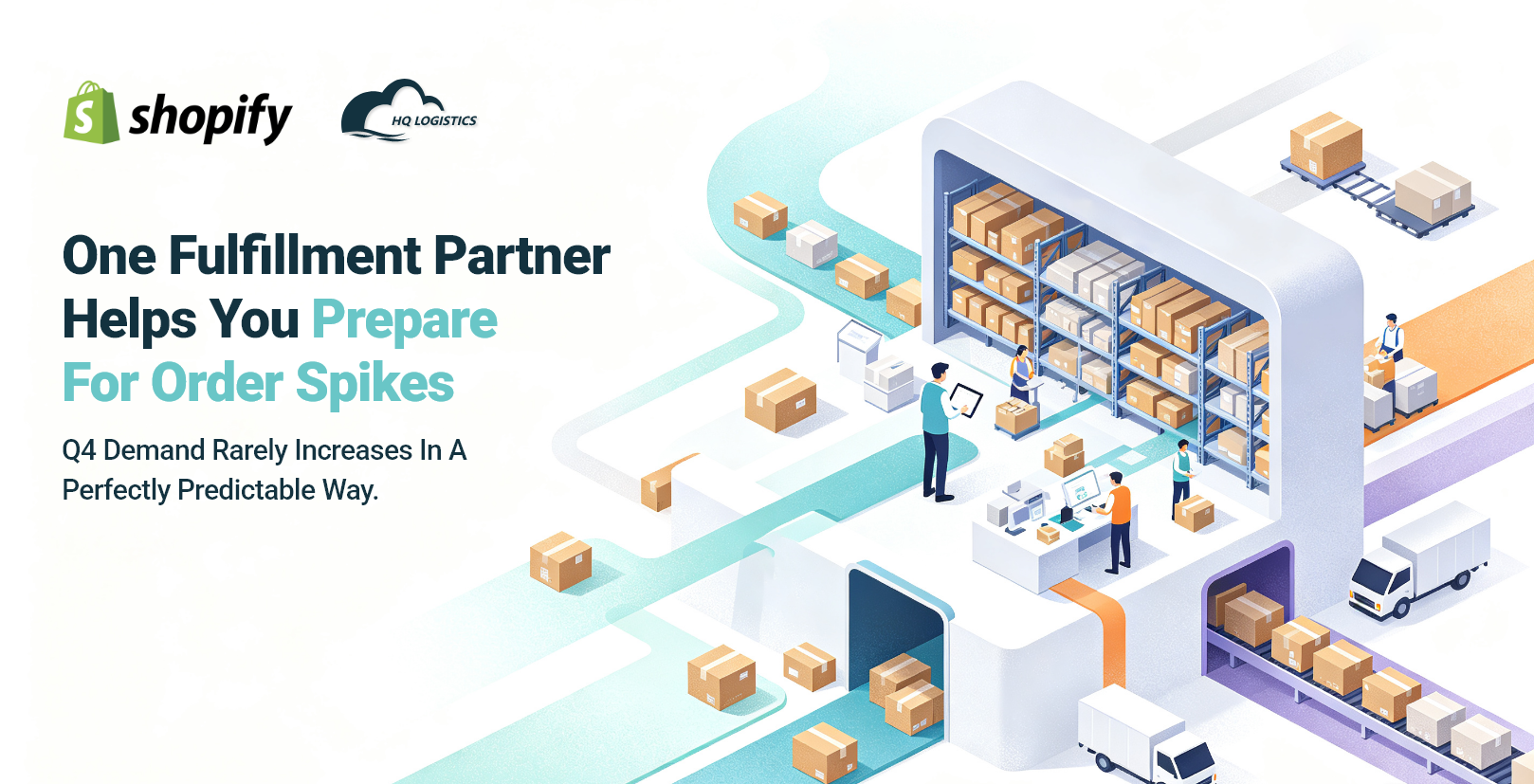
7. A Single Partner Can Improve Cost Visibility
Your true fulfillment cost is more than your shipping rate.
It can include product cost, quality control, packaging, storage, order processing, shipping, and returns.
When these services are spread across different companies, it can be difficult to understand your total supply chain cost.
An integrated partner can help you evaluate the full picture.
For example:
Maybe a cheaper product has a longer production lead time.
Maybe cheaper packaging creates more damage.
Maybe a low shipping rate comes with slower delivery.
Maybe storing everything in one location increases cross-border shipping costs.
Instead of optimizing one individual cost, you can optimize:
Total Cost Per Delivered Order
That's a much better metric for a growing Shopify brand.
8. One Supply Chain Gives You One Point of Accountability
This is one of the biggest advantages.
When something goes wrong in a fragmented supply chain, you may hear:
“The supplier is waiting for the warehouse.”
“The warehouse is waiting for the shipping agent.”
“The shipping agent is waiting for the carrier.”
And meanwhile, your customer is waiting for the order.
With one supply chain partner, there is a clearer point of accountability.
Instead of asking five companies what happened, you can work with one partner to identify:
What happened?
Where is the bottleneck?
What is the solution?
How do we prevent it next time?
For Q4, that clarity can be extremely valuable.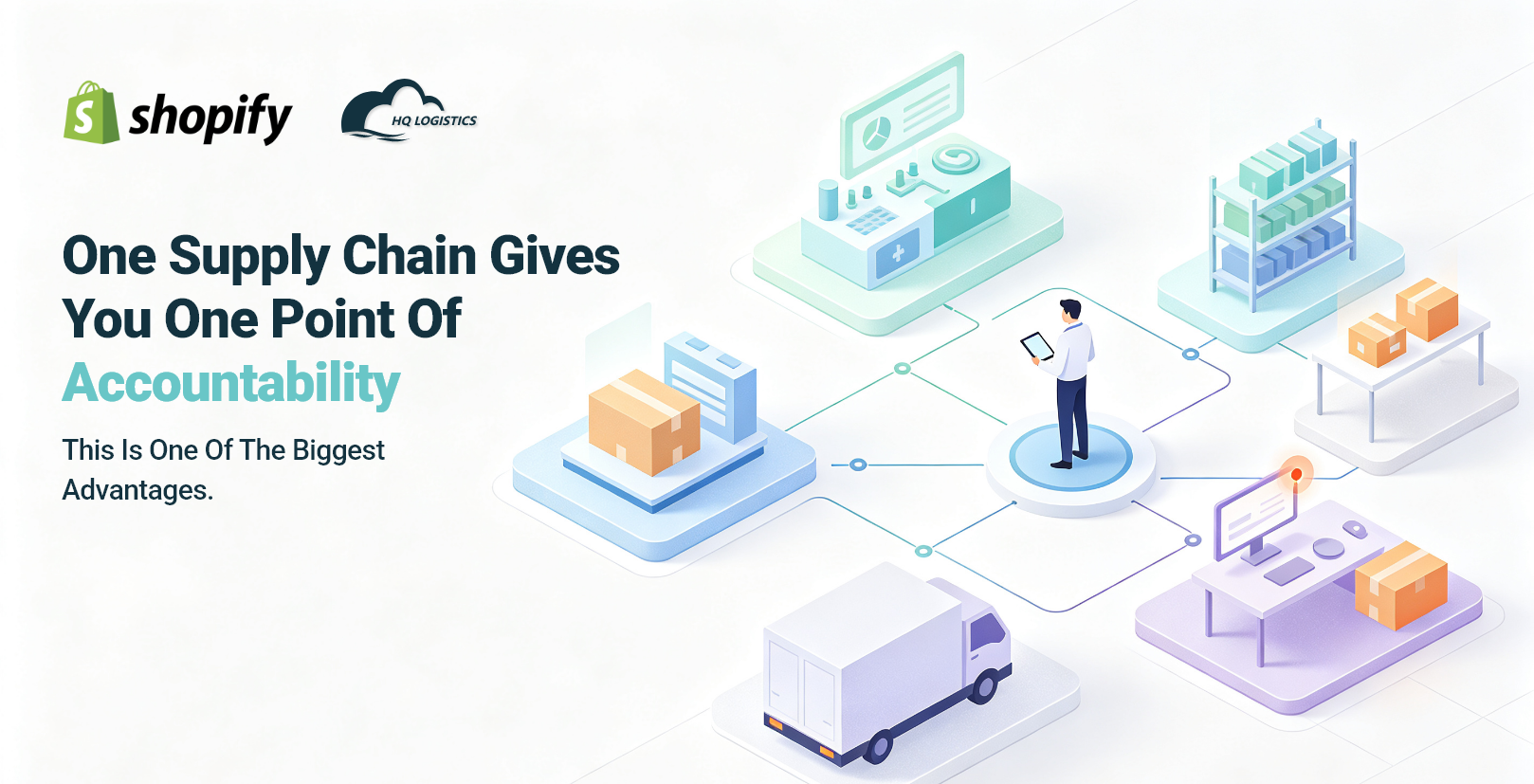
One Partner vs. Multiple Providers
| Multiple Providers | One Supply Chain Partner |
|---|---|
| Multiple supplier contacts | One main point of contact |
| Separate sourcing | Connected sourcing |
| Separate QC | QC linked to sourcing |
| Independent inventory planning | Integrated inventory planning |
| Multiple warehouse communications | Coordinated warehousing |
| Separate fulfillment operations | Connected fulfillment |
| Multiple shipping contacts | Centralized shipping coordination |
| Fragmented data | Better supply chain visibility |
| Reactive problem solving | Proactive planning |
| You manage the connections | Partner manages the workflow |
The objective isn't simply to have fewer vendors.
It's to have fewer gaps between vendors.
How to Prepare Your Shopify Brand for Q4
A successful Q4 supply chain should be prepared before your biggest campaigns launch.
Here's a practical timeline.
8–12 Weeks Before Peak
Review Your Products
Identify:
Bestsellers | Fast-growing SKUs | Seasonal products | High-margin products | Products with frequent stockouts
Review Your Suppliers
Confirm:
Production capacity | Lead times | Pricing | Product specifications | Replenishment capabilities
Build Your Forecast
Use historical sales, current growth, planned promotions, and marketing activity to estimate Q4 demand.
Shopify recommends comparing forecasts with actual sales regularly and increasing forecast frequency during peak holiday periods.
4–8 Weeks Before Peak
Secure Inventory
Place purchase orders for priority SKUs.
Complete Quality Checks
Inspect products before large quantities enter fulfillment inventory.
Prepare Packaging
Make sure branded packaging, labels, inserts, and other materials are ready.
Position Inventory
Determine whether products should remain in China or move to US, EU, or other regional warehouses.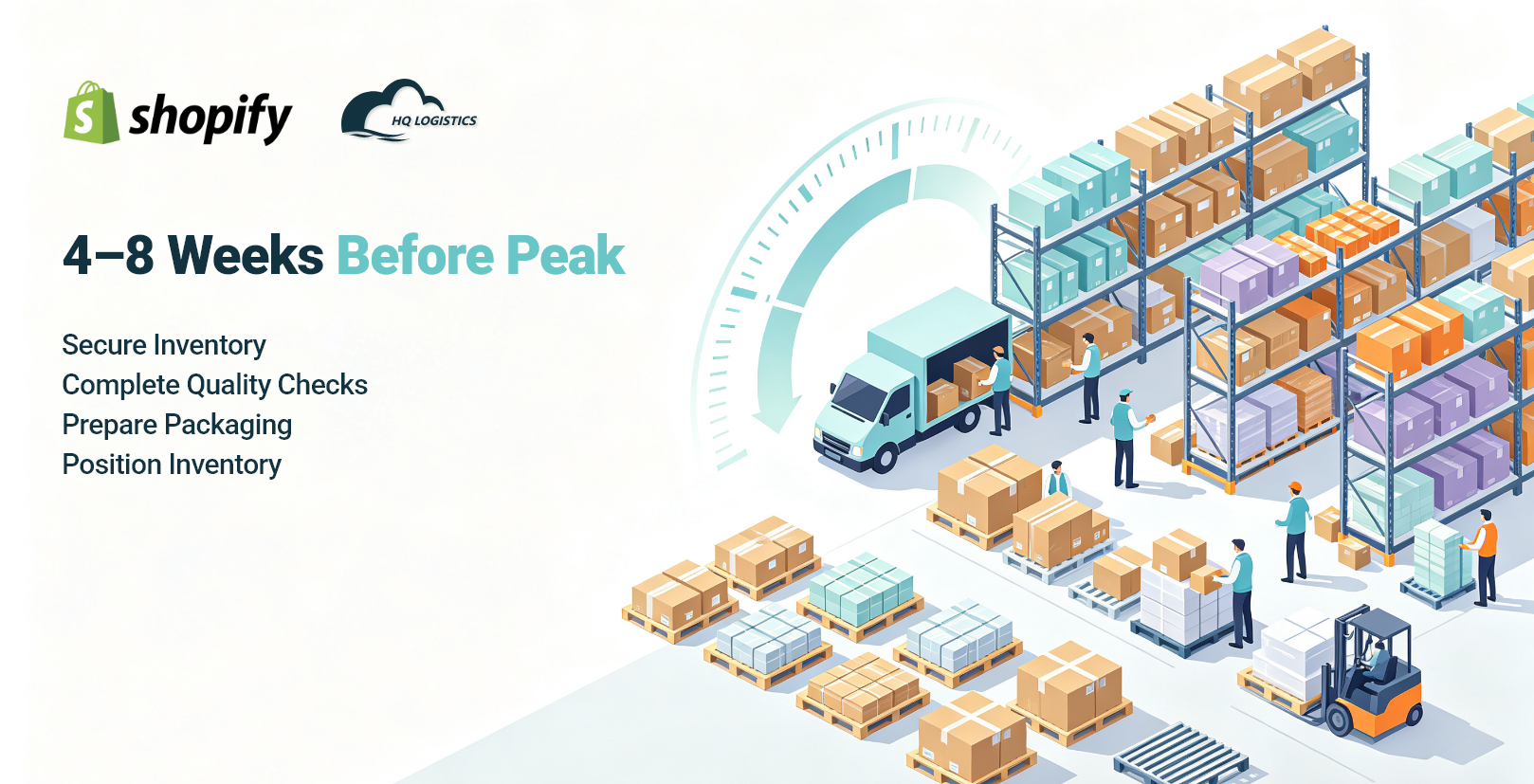
1–4 Weeks Before Peak
Test Fulfillment
Check:
Order syncing | Picking | Packing | Tracking | Shipping routes | Exception handling
Confirm Capacity
Make sure your warehouse and shipping partners are prepared for the expected order volume.
Monitor Inventory Daily
Your forecast should not be treated as a fixed number.
Compare expected demand with actual sales and adjust quickly.
The Right Q4 Partner Should Think Beyond Shipping
When evaluating a supply chain partner, don't just ask:
“How much does shipping cost?”
Ask:
Can you source my products?
Can you negotiate with factories?
Can you inspect product quality?
Can you help forecast inventory?
Can you manage China inventory?
Can you support overseas warehousing?
Can you handle peak fulfillment volume?
Can you provide custom packaging?
Can you integrate with Shopify?
Can you provide real-time inventory and tracking visibility?
Can you help me scale after Q4?
If the answer is yes across the supply chain, you're not simply choosing a fulfillment provider.
You're choosing a growth partner.
How HQ Supports a One-Partner Supply Chain
For Shopify brands preparing for Q4, HQ brings multiple supply chain functions together under one partner.
The workflow can connect:
Sourcing → Supplier Management → Quality Control → Inventory → Customization → Warehousing → Fulfillment → Global Shipping
HQ can support:
Factory-direct sourcing | No-MOQ product testing | Supplier management | Quality inspection | Product photography | Custom packaging | Private labeling | China warehousing | Overseas warehousing | Shopify integration | Automated order fulfillment | Real-time inventory and tracking | Global shipping solutions | Inventory planning and replenishment
Instead of coordinating several disconnected providers, brands can work with one supply chain partner across the major stages of their operation.
The goal is simple:
One Partner. One Supply Chain. Less Complexity. More Control.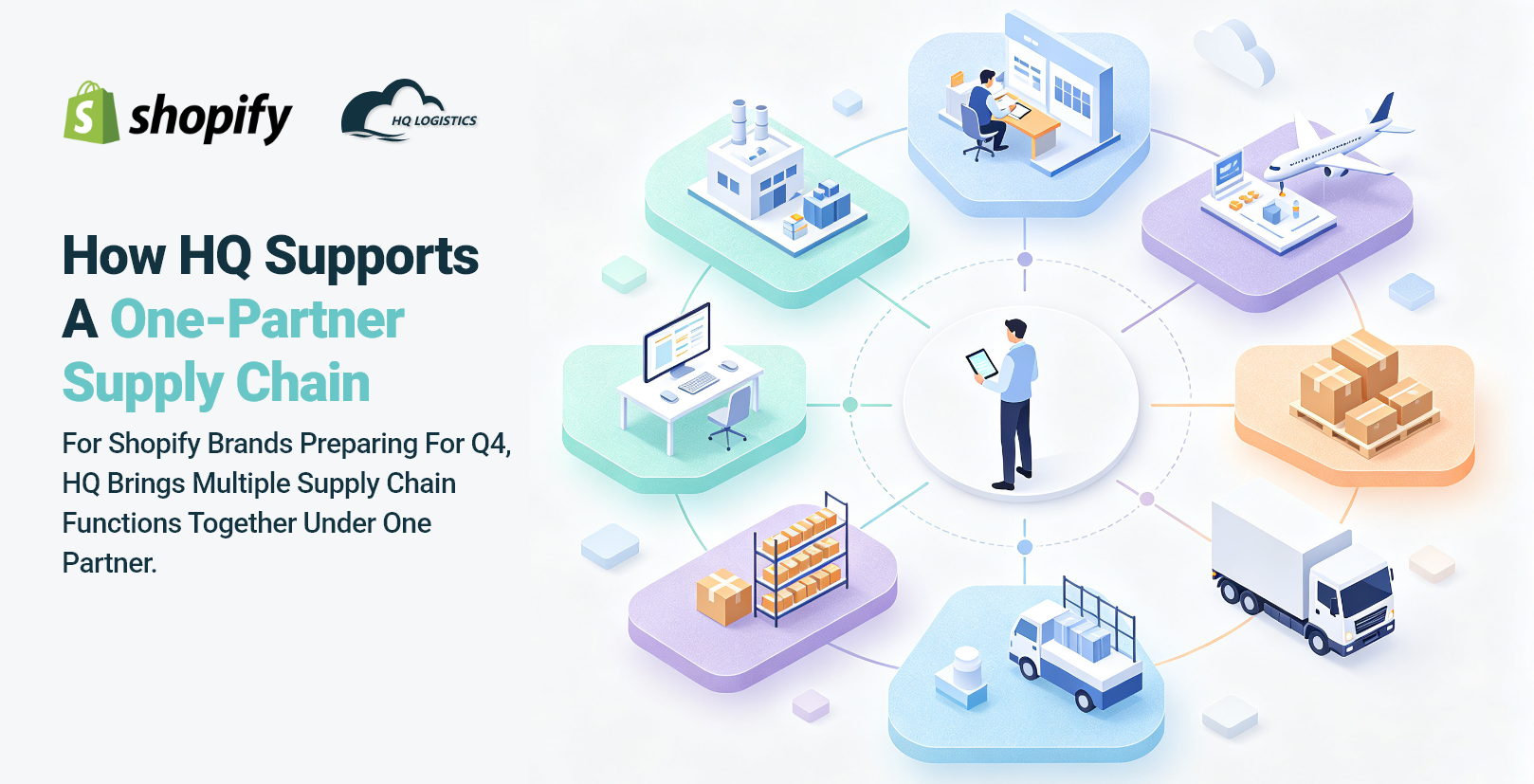
Q4 Supply Chain Checklist
Before peak season begins, make sure you can answer “yes” to these questions:
Sourcing
☐ Are my suppliers confirmed?
☐ Can they handle higher demand?
☐ Are product costs competitive?
Inventory
☐ Have I created a Q4 demand forecast?
☐ Do I have enough safety stock?
☐ Are my best-selling SKUs prioritized?
Quality
☐ Have priority products been inspected?
☐ Are product specifications confirmed?
Warehousing
☐ Is there enough warehouse capacity?
☐ Is inventory positioned near key customers?
☐ Are packaging materials ready?
Fulfillment
☐ Has the order workflow been tested?
☐ Can the warehouse handle peak volume?
☐ Is tracking synchronized?
Shipping
☐ Are primary shipping routes confirmed?
☐ Do I have backup options?
☐ Are delivery expectations realistic?
Communication
☐ Does everyone have the same Q4 forecast?
☐ Is inventory monitored regularly?
☐ Is there one clear point of contact?
If you can't confidently answer these questions, now is the time to prepare.
Final Thoughts
Q4 isn't just a test of your Shopify store.
It's a test of your entire supply chain.
Your marketing team can create demand.
Your Shopify store can convert customers.
But your supply chain determines whether you can actually deliver on that demand.
When sourcing, inventory, warehousing, fulfillment, and shipping are managed separately, you spend more time connecting the pieces.
When those stages work together, you can focus more on what matters:
Selling, scaling, and building your brand.
That's the value of having one supply chain partner.
One Partner. One Supply Chain. One Less Thing to Worry About.
Prepare early.
Connect your operations.
And make sure your supply chain is ready before Q4 gets busy.
FAQs
Why should Shopify brands use one supply chain partner?
A single partner can reduce communication gaps between sourcing, inventory, warehousing, fulfillment, and shipping. It can also provide clearer accountability and make it easier to coordinate changes during peak season.
Is one fulfillment partner always better than multiple suppliers?
Not necessarily. Different businesses may need specialized providers. However, as a Shopify brand grows, consolidating key supply chain functions with one strategic partner can reduce operational complexity.
When should I start preparing my supply chain for Q4?
Ideally, preparation should begin well before peak sales events. Start with demand forecasting and supplier planning, then secure inventory, prepare warehouses, test fulfillment, and confirm shipping capacity before major campaigns launch.
Should I move inventory to an overseas warehouse before Q4?
If a significant share of your customers is concentrated in a particular region, positioning inventory closer to those customers can be worth considering. The decision should account for demand, inventory turnover, shipping costs, product characteristics, and replenishment lead times.
What should I look for in a Q4 fulfillment partner?
Look beyond shipping rates. Evaluate sourcing, supplier management, quality control, inventory planning, warehousing, fulfillment capacity, technology integration, custom packaging, shipping options, and scalability.