Q4 Fulfillment Comparison: CJ Dropshipping vs. HQ for Growing Shopify Brands
Q4 Fulfillment Comparison: CJ Dropshipping vs. HQ for Growing Shopify Brands
Q4 changes the rules for Shopify brands.
During quieter months, a dropshipping model can be enough to run your store.
You can test products.
You can place orders as they come in.
You can avoid holding large amounts of inventory.
But when Q4 arrives, everything becomes more demanding.
More orders. More SKUs. More inventory. More customer expectations. More pressure on fulfillment.
A system that works well for product testing may not always be the best setup for a brand that is processing hundreds or thousands of orders during peak season.
That's why many growing Shopify brands start asking a different question:
Should I continue with my current dropshipping setup, or is it time to move to a more scalable fulfillment partner?
CJ Dropshipping and HQ both offer sourcing, fulfillment, warehousing, shipping, and Shopify-related services. However, their positioning and workflows can be different depending on what a seller needs.
CJ promotes product sourcing, automated Shopify fulfillment, global warehouses, and low-barrier dropshipping.
HQ focuses on combining sourcing, inventory, warehousing, fulfillment, customization, and global shipping into a connected fulfillment workflow for growing ecommerce brands.
So the real question isn't:
“Which platform is better?”
It's:
“Which fulfillment model fits my Shopify brand at its current stage—and where I want to go next?”
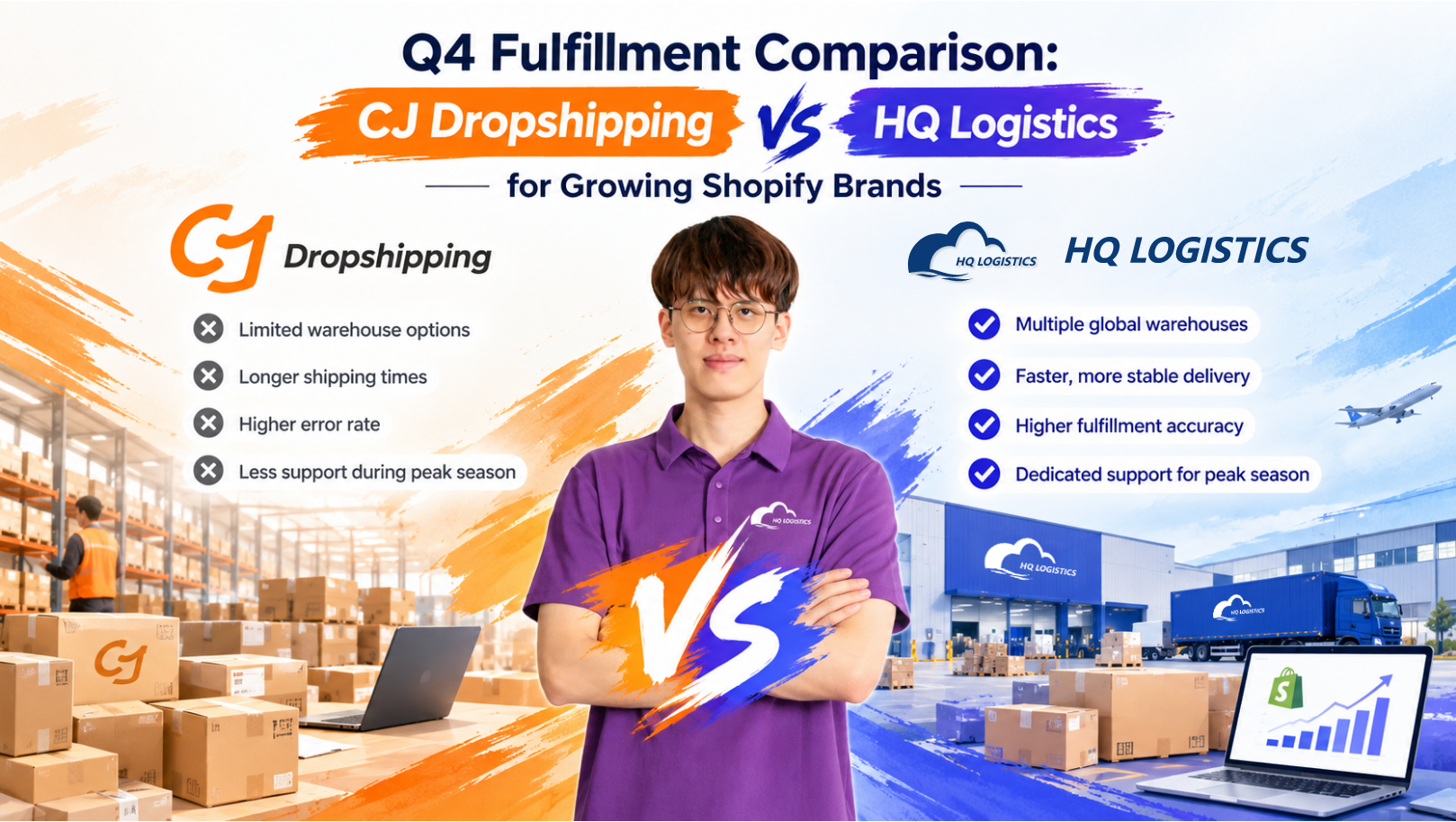
CJ Dropshipping vs. HQ: At a Glance
Before going deeper, here's a high-level comparison for Shopify sellers preparing for Q4.
| Area | CJ Dropshipping | HQ |
|---|---|---|
| Product sourcing | Strong product marketplace + sourcing requests | Factory sourcing + sourcing support |
| Product testing | Excellent for low-commitment testing | No-MOQ sourcing and fulfillment |
| Shopify integration | Automated order, inventory, and tracking sync | Shopify integration + automated fulfillment |
| Global warehouses | Multiple global warehouse options | China + overseas fulfillment support |
| Inventory model | Dropshipping or pre-stocked inventory | Flexible sourcing + China/overseas inventory |
| Quality control | Product/order quality checks available | Quality inspection before fulfillment |
| Custom packaging | Available | Custom packaging + branding support |
| Branding | Available | Custom branding and packaging |
| Fulfillment | Automated dropshipping fulfillment | Integrated fulfillment workflow |
| Sourcing + fulfillment | Connected | Connected |
| Q4 scalability | Suitable for growing stores | Designed around growing/high-volume brands |
| Supply chain approach | Dropshipping-centered | End-to-end fulfillment-centered |
The important distinction is not that one company offers fulfillment and the other doesn't.
Both do.
The bigger difference is how you use the service as your business evolves.
1. Product Testing: CJ Has a Strong Low-Risk Model
For a new Shopify seller, product testing is often the first priority.
You may want to test:
10 products → 20 products → 50 products
without purchasing large quantities upfront.
This is where CJ Dropshipping can be attractive.
CJ provides a large product catalog and allows sellers to submit sourcing requests when they can't find a product in the existing catalog. Its Shopify integration supports product connection, order syncing, and inventory synchronization.
This makes sense for brands that are still asking:
“Which product should I scale?”
For early-stage dropshipping, flexibility can be more important than building a sophisticated supply chain.
Where HQ Fits
HQ also supports no-MOQ sourcing and can source products based on a product image or request. Its model is more centered around connecting sourcing with fulfillment, warehousing, quality inspection, and shipping.
That can become more useful when the question changes from:
“Can I test this product?”
to:
“How do I build a repeatable supply chain around this product?”
2. Product Sourcing: From Finding Products to Managing Suppliers
Product sourcing becomes more important as a store grows.
At the testing stage, you mainly care about:
Product availability + Price + Shipping
At the scaling stage, you may also care about:
Factory capacity + Quality consistency + Packaging + Lead time + Replenishment + Product customization
CJ provides sourcing services and a large product network, while HQ positions sourcing as part of a broader fulfillment workflow.
This distinction matters during Q4.
Imagine one of your products suddenly goes viral.
Your problem is no longer simply finding the product.
You need to know:
Can the supplier produce more?
How quickly can inventory be replenished?
Can quality remain consistent?
Can packaging be customized?
Where should the inventory be stored?
How quickly can the next batch enter fulfillment?
At this stage, sourcing and fulfillment shouldn't be treated as separate operations.
3. Inventory: Dropshipping vs. Strategic Pre-Stocking
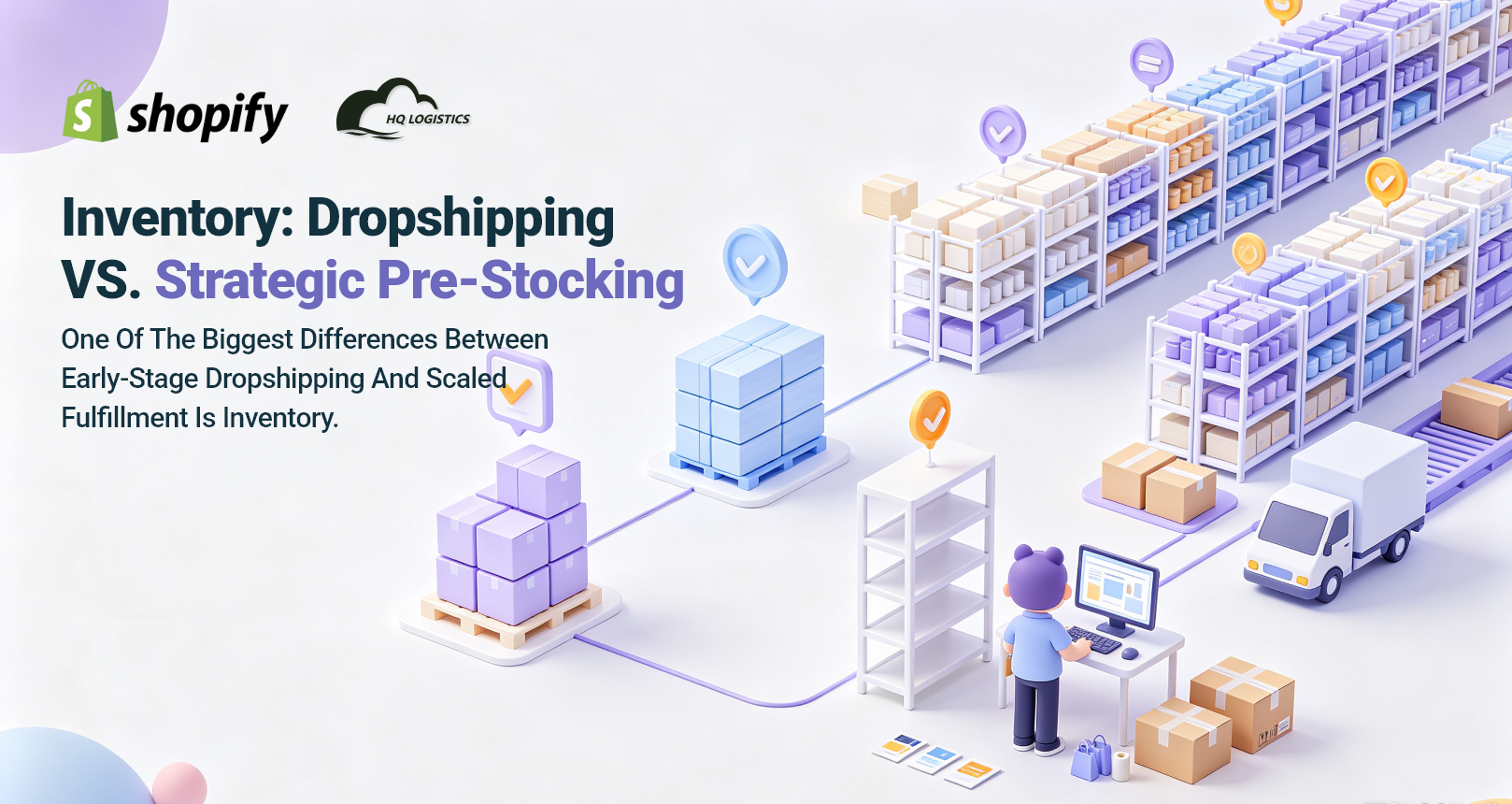
One of the biggest differences between early-stage dropshipping and scaled fulfillment is inventory.
Dropshipping Model
Customer Order → Supplier/Fulfillment → Customer
You don't need to hold much inventory yourself.
This reduces upfront inventory risk.
Pre-Stocked Fulfillment Model
Supplier → Warehouse → Customer
You purchase or allocate inventory in advance and store it closer to your customers.
This can improve:
Delivery speed
Fulfillment consistency
Peak-season capacity
Inventory availability
CJ supports both dropshipping and pre-stocked fulfillment through its warehouse network. Its 3PL service allows sellers to send products to CJ warehouses for storage, packing, and delivery.
HQ similarly combines sourcing with pre-stocking and fulfillment, including China warehousing and overseas fulfillment options.
For Q4, the important question is:
Which products should you pre-stock?
You don't necessarily need to move every SKU into an overseas warehouse.
A smarter approach is:
Test → Identify Winners → Pre-Stock Winners → Replenish → Scale
4. Q4 Changes the Importance of Inventory
During normal months, a few extra days of delivery may be manageable.
During Q4, the consequences can be different.
Customers are buying for:
Black Friday
Cyber Monday
Christmas
Holiday gifting
Limited-time promotions
If delivery takes too long, customers may cancel or choose another store.
That's why successful Q4 fulfillment often requires a different inventory strategy.
Instead of fulfilling every order individually from the sourcing location, brands can pre-position proven bestsellers in regional warehouses.
CJ promotes global warehouse fulfillment and local shipping options, including US and EU warehouses.
HQ also supports China and overseas warehousing, with its fulfillment service designed to connect inventory management with order processing and shipping.
The key is not simply:
“Who has more warehouses?”
It's:
“Who can help me position the right inventory before Q4 demand arrives?”
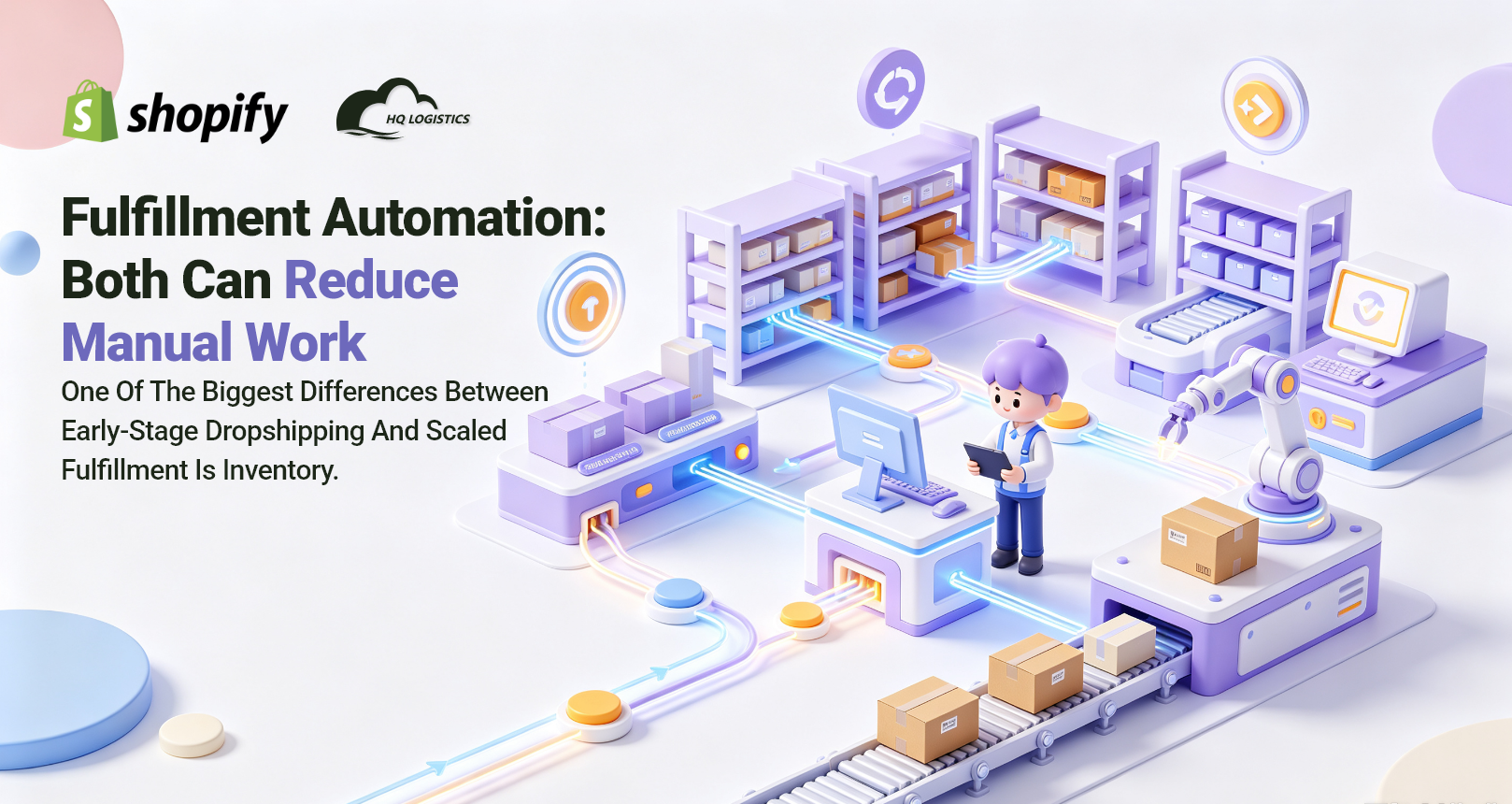
5. Fulfillment Automation: Both Can Reduce Manual Work
Growing Shopify brands shouldn't be managing hundreds of orders through spreadsheets.
Automation becomes essential.
CJ supports:
Shopify → Order Sync → Fulfillment → Tracking Sync
Its Shopify integration automatically connects store orders and supports inventory synchronization.
HQ also supports Shopify integration, automatic order fulfillment, and real-time tracking synchronization.
For both models, automation can help reduce:
Manual order entry
Tracking updates
Inventory errors
Order processing time
But during Q4, automation is only one part of the equation.
You also need the physical operation behind it to scale.
6. The Real Q4 Test Is Fulfillment Capacity
Imagine your store normally receives:
100 orders/day
Then Black Friday arrives.
Orders jump to:
500 orders/day
And then:
800 orders/day
Your Shopify integration may still work perfectly.
But can the warehouse?
This is where fulfillment capacity becomes critical.
You need enough:
Inventory
Pickers
Packing stations
Packaging materials
Warehouse space
Carrier capacity
Customer support
A good Q4 fulfillment partner should be able to prepare for volume before the spike happens.
HQ positions its service around same-day pick, pack, branding, and shipping, with its site also highlighting 24-hour dispatch and fulfillment support for growing/high-volume ecommerce businesses.
CJ also provides fulfillment through its warehouse network and supports pre-stocked inventory for sellers.
For your own evaluation, ask:
“What happens if my order volume suddenly triples?”
That's a much better Q4 question than simply:
“What's your normal processing time?”
7. Branding Becomes More Important as Your Store Grows
Early-stage dropshipping is often about getting the product to the customer.
Growing brands start thinking differently.
They want the customer to remember their brand, not the supplier.
That means:
Custom packaging
Branded labels
Thank-you cards
Product inserts
Custom bags
Private labeling
CJ offers customized packaging and branding options.
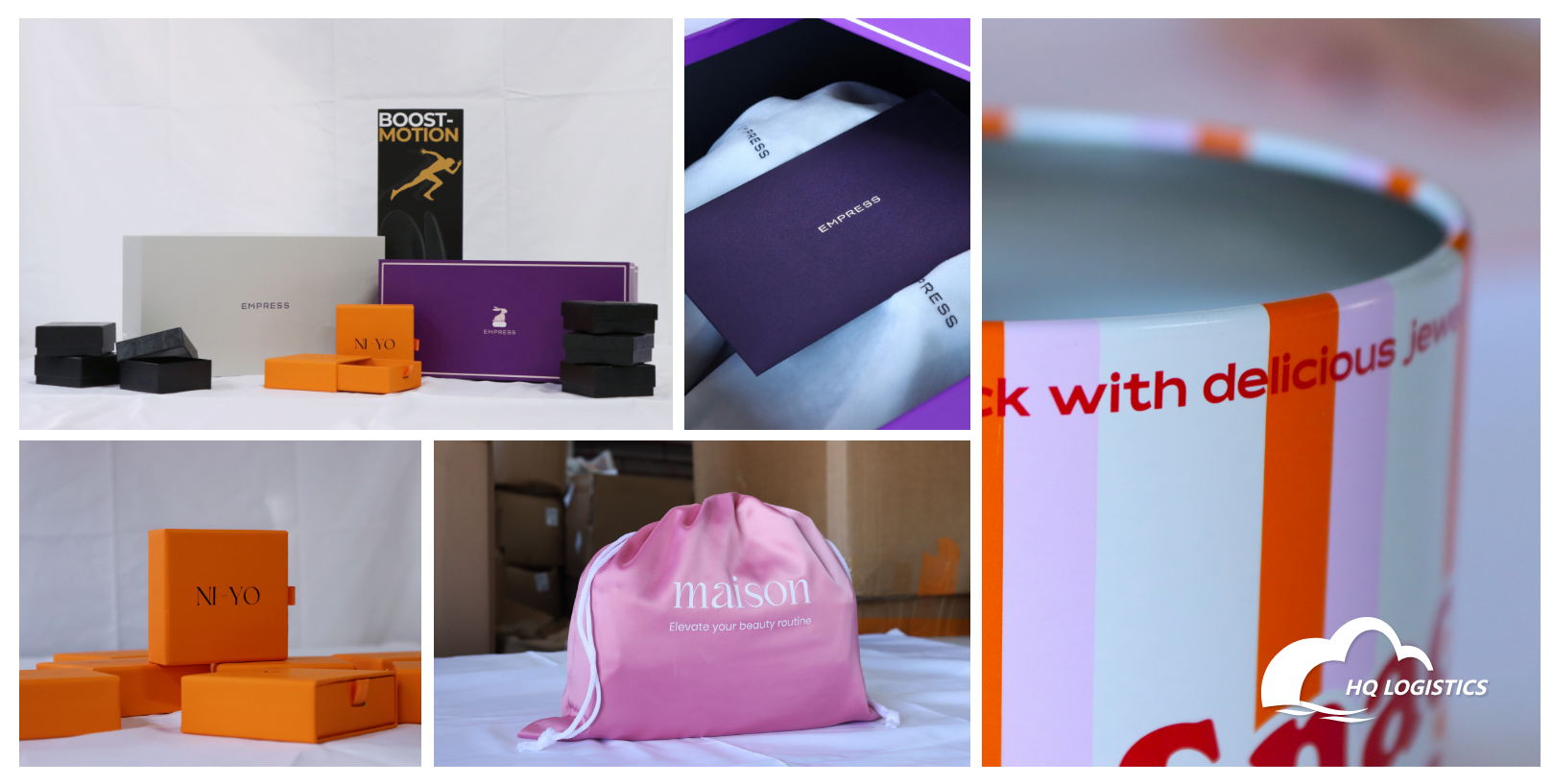
HQ also supports custom packaging, customized labels, branding, and related fulfillment services.
The difference comes down to how deeply branding is integrated into your overall fulfillment workflow.
For a growing brand, you may eventually want:
Sourcing → QC → Branding → Packaging → Fulfillment → Shipping
instead of adding branding as a separate step.
8. Quality Control Matters More When Order Volume Increases
Imagine selling 20 units of a product.
One defective item is a problem.
Now imagine selling 2,000 units.
A small quality issue can become hundreds of customer complaints.
That's why quality control becomes increasingly important as order volume grows.
CJ provides quality checks as part of its fulfillment services. Its 3PL documentation describes product inspection before stocking and checks before dispatch.
HQ similarly emphasizes quality inspection before inventory is stocked and before orders are dispatched.
For Q4, ask your fulfillment partner:
When is QC performed?
Before inventory enters the warehouse?
Before each order ships?
Can defective inventory be isolated?
Can product photos or inspection evidence be provided?
The earlier a quality issue is detected, the cheaper it is to fix.
9. CJ vs. HQ: Which Model Fits Your Business?
The answer depends heavily on your current stage.
Choose a CJ-Style Dropshipping Model If:
You are still testing many products.
You want a large product catalog.
You prefer low upfront inventory commitment.
You want a ready-made dropshipping workflow.
You are still determining which products will become winners.
CJ's current Shopify offering is built around product discovery, sourcing, automated fulfillment, inventory synchronization, and global warehouse options.
Consider HQ If:
You already have products that consistently sell.
You are increasing daily order volume.
You need stronger supplier coordination.
You want sourcing and fulfillment managed together.
You need more control over inventory.
You want custom packaging and branding.
You are preparing for Q4 volume.
You want a more connected supply chain rather than only a dropshipping workflow.
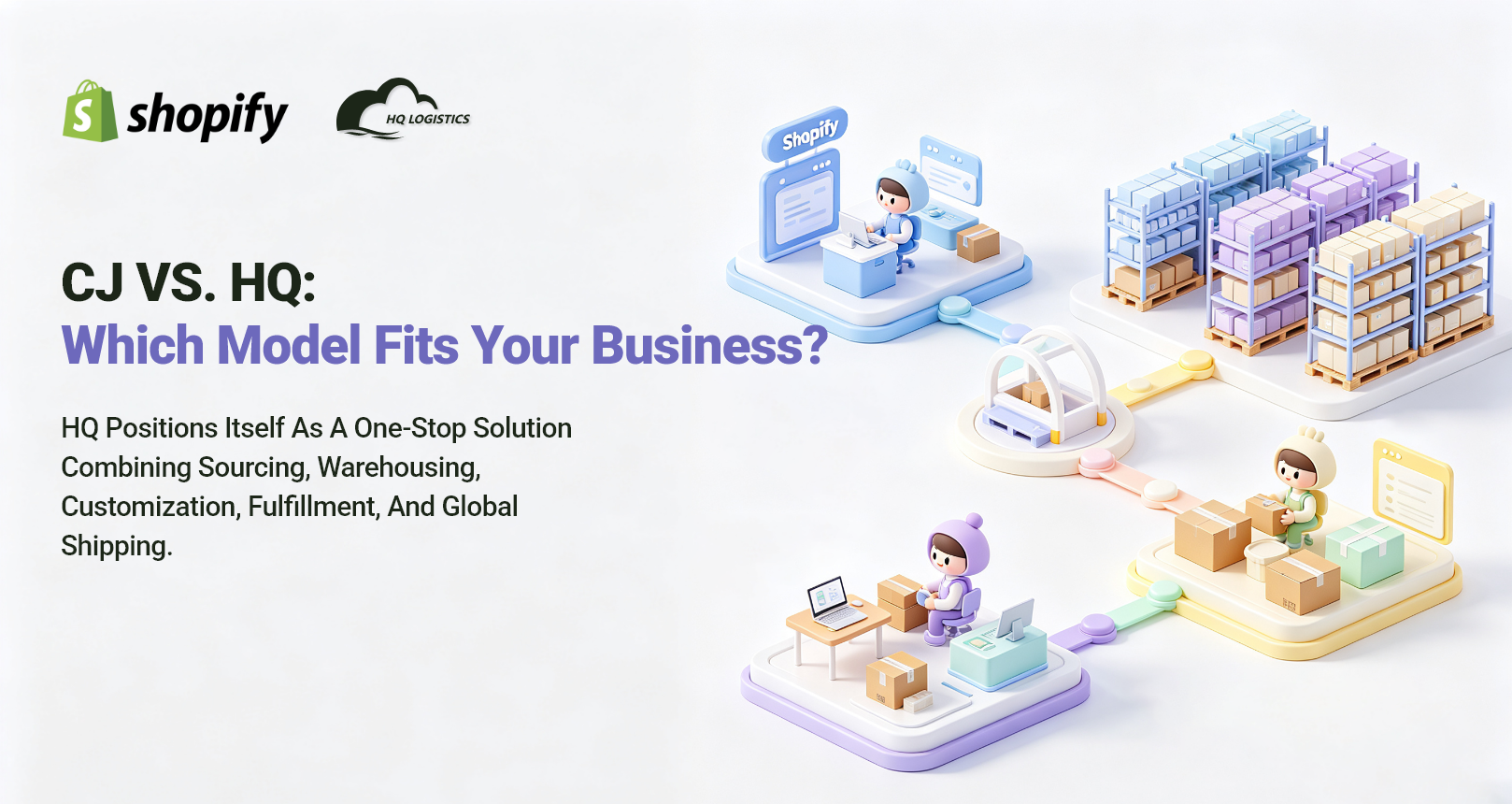
HQ positions itself as a one-stop solution combining sourcing, warehousing, customization, fulfillment, and global shipping.
10. CJ vs. HQ for Different Shopify Growth Stages
| Shopify Stage | Main Challenge | Potentially Better Fit |
|---|---|---|
| Product testing | Finding products | CJ-style dropshipping |
| Early sales | Keeping costs flexible | Dropshipping |
| Growing sales | Reliable fulfillment | CJ or HQ |
| 100+ daily orders | Capacity + inventory | Compare fulfillment partners |
| Multiple markets | Inventory positioning | Integrated fulfillment |
| Strong brand growth | Branding + supply chain | HQ-style model |
| Q4 scaling | Inventory + capacity + speed | Strategic fulfillment partner |
| High-volume operation | End-to-end coordination | Integrated supply chain |
There is no requirement to switch providers simply because your store grows.
But your fulfillment requirements should evolve as your business does.
What Growing Shopify Brands Should Compare Before Q4
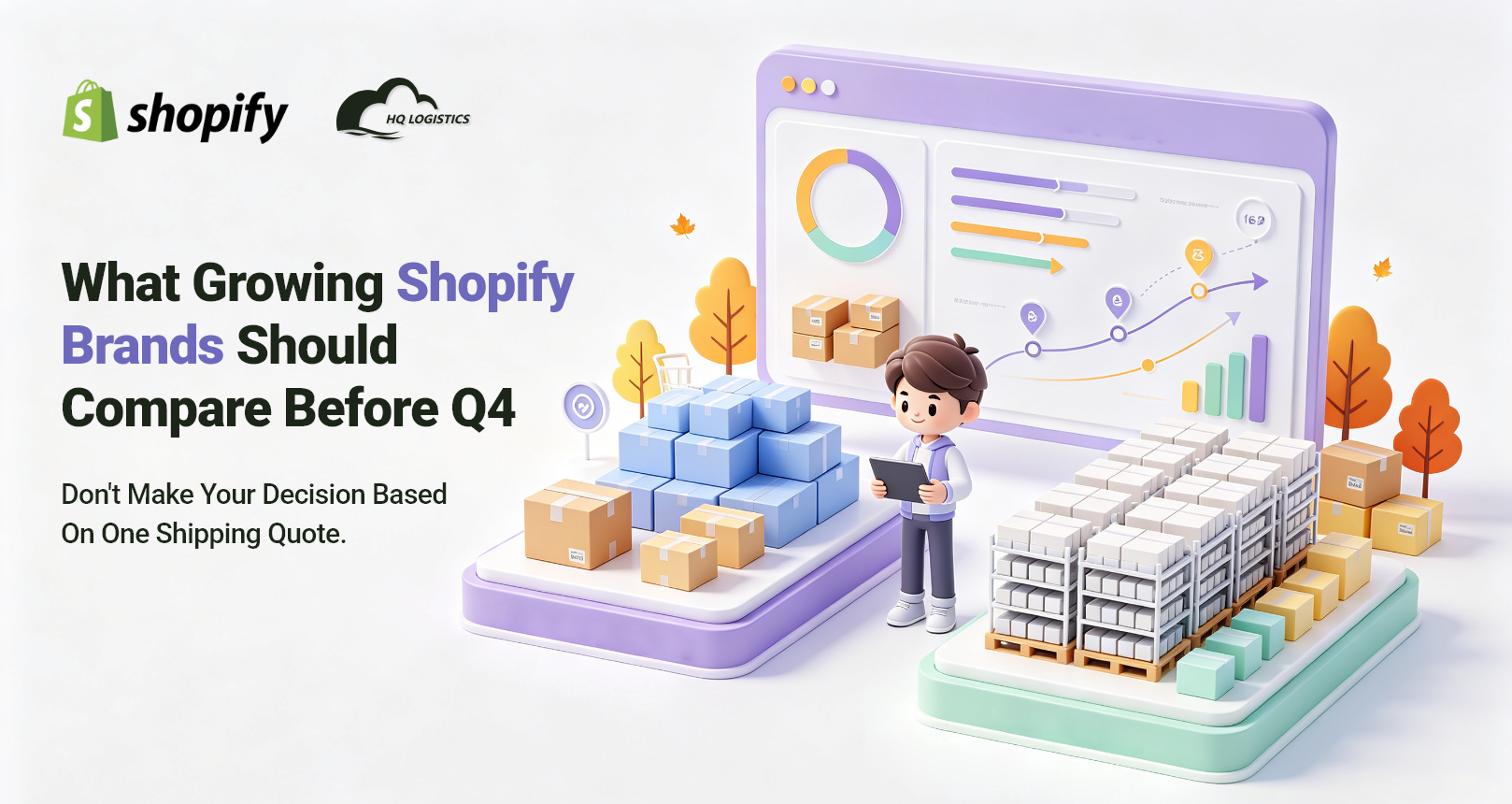
Don't make your decision based on one shipping quote.
Build a complete comparison.
Product Sourcing
Can the partner source products directly from factories?
Pricing
What is your total cost per delivered order?
Inventory
Can you pre-stock bestsellers?
Warehousing
Where can your inventory be stored?
Fulfillment
How does the partner handle sudden order spikes?
Shipping
What routes and delivery speeds are available?
Technology
Can orders, inventory, and tracking sync automatically?
Quality
What quality checks happen before products reach customers?
Branding
Can you customize packaging and labels?
Replenishment
How quickly can inventory be restocked?
Support
Who handles problems when something goes wrong?
The cheapest fulfillment provider isn't necessarily the most profitable.
The better question is:
Which partner gives your business the best total fulfillment performance?
Q4 Fulfillment Comparison: What Matters Most?
For growing Shopify brands, the priorities usually change as the business matures.
| Priority | Early-Stage Store | Growing Brand | Q4 Scaling Brand |
|---|---|---|---|
| Product selection | ★★★★★ | ★★★★ | ★★★ |
| Low upfront risk | ★★★★★ | ★★★★ | ★★★ |
| Inventory control | ★★ | ★★★★ | ★★★★★ |
| Delivery speed | ★★★ | ★★★★ | ★★★★★ |
| Fulfillment capacity | ★★ | ★★★★ | ★★★★★ |
| Branding | ★★ | ★★★★ | ★★★★★ |
| Supplier management | ★★ | ★★★★ | ★★★★★ |
| Replenishment | ★★ | ★★★★ | ★★★★★ |
| Supply chain visibility | ★★★ | ★★★★ | ★★★★★ |
The lesson is simple:
The fulfillment model that is perfect for a new store may not be perfect for a scaling brand.
Why Q4 Is a Good Time to Re-Evaluate Your Fulfillment Partner
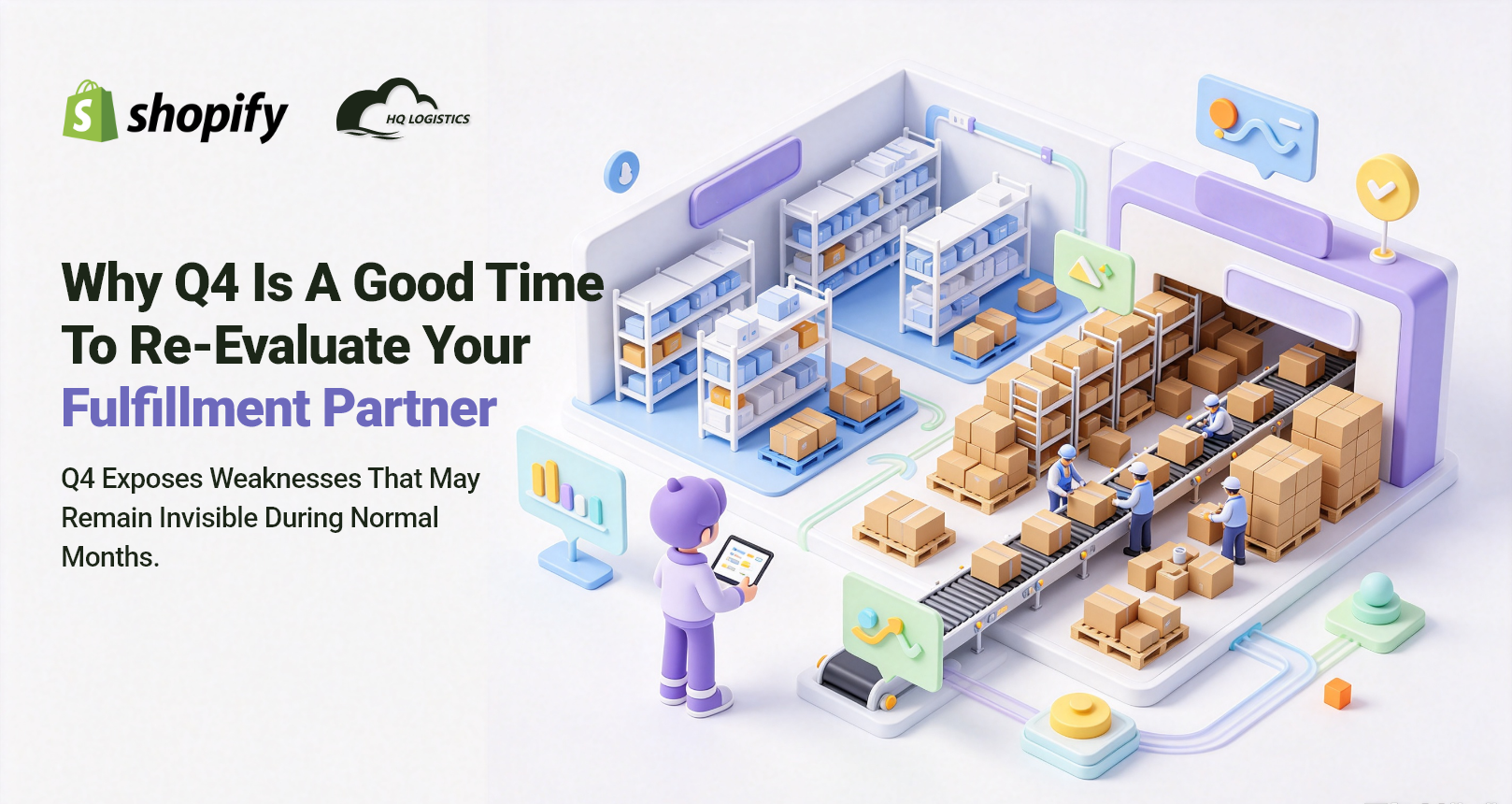
Q4 exposes weaknesses that may remain invisible during normal months.
Ask yourself:
Are shipping costs becoming harder to control?
Are stockouts happening more frequently?
Are orders taking longer to process?
Are you manually managing too many fulfillment tasks?
Are suppliers struggling to keep up with demand?
Do you have enough inventory in your key markets?
Can your current partner handle 2–3× your normal order volume?
If several answers are “no,” the problem may not be your Shopify store.
It may be your fulfillment infrastructure.
How HQ Supports Growing Shopify Brands During Q4
HQ is designed around a more connected fulfillment model.
Instead of treating sourcing, inventory, warehousing, fulfillment, and shipping as separate services, HQ connects them into one workflow:
Sourcing → Quality Control → Inventory → Customization → Warehousing → Fulfillment → Global Shipping
Its current service offering includes no-MOQ sourcing, free storage, quality inspection, Shopify integration, automated order fulfillment, custom branding, and real-time inventory/tracking synchronization. HQ also promotes special shipping lines to the U.S. and Europe.
For growing Shopify brands, that means you can build a workflow around your actual growth stage:
Test Products → Identify Winners → Pre-Stock Inventory → Build Branding → Scale Fulfillment → Expand to More Markets
Instead of constantly changing suppliers as your store grows, the goal is to build a fulfillment system that can grow with you.
Final Thoughts: It's Not Really CJ vs. HQ
CJ Dropshipping can be a strong option for Shopify sellers who value product discovery, low-barrier testing, automated dropshipping, and access to a broad sourcing and warehouse ecosystem.
HQ can be a strong fit for brands that are moving beyond basic product testing and want a more integrated approach to sourcing, inventory, branding, warehousing, fulfillment, and shipping.
So the real question isn't:
“Which company is better?”
It's:
“What does my business need next?”
If you're still testing products, flexibility may matter most.
If you're scaling proven winners, inventory control and fulfillment capacity become more important.
If you're entering Q4 with hundreds or thousands of orders, your fulfillment partner needs to be more than a shipping provider.
It needs to be part of your growth strategy.
Test Smart. Scale Faster. Fulfill Better.
And before Q4 arrives, make sure your fulfillment partner is ready for the business you're building—not just the business you have today.
FAQs
Is CJ Dropshipping good for Shopify stores?
CJ Dropshipping offers Shopify integration, product sourcing, automated fulfillment, inventory synchronization, and global warehouse options, making it suitable for many dropshipping and ecommerce businesses.
When should a Shopify seller consider switching fulfillment partners?
There is no universal order threshold. Consider switching or evaluating alternatives when order volume, SKU count, inventory requirements, branding needs, or fulfillment complexity begin exceeding what your current setup can comfortably support.
Is HQ better than CJ for Q4?
It depends on the store. CJ can work well for sellers who want a flexible dropshipping model and broad product sourcing. HQ may be a better fit for growing brands that want integrated sourcing, inventory, customization, warehousing, fulfillment, and shipping.
Should I pre-stock inventory for Q4?
For proven bestsellers, pre-stocking can help reduce fulfillment lead times and improve availability during peak demand. New or uncertain products may be better suited to smaller test quantities until demand becomes clearer.
What should I compare when choosing a Q4 fulfillment partner?
Compare the complete cost and workflow—not just shipping rates. Look at sourcing, inventory, warehouse locations, processing capacity, delivery speed, Shopify integration, quality control, branding, replenishment, tracking, and customer support.